
Why was born into slavery, created by Jean Baptiste Calvo

Why was born into slavery, created by Jean Baptiste Calvo

As one of the most powerful expressions of abolitionist sentiment in visual art, "Why Born Enslaved!" depicts an African woman who is bound by ropes and provocatively looks up. The rope painfully pressed against her breasts; Her tattered shirt hinted at the violence that caused her illness. The original colored surface is covered with complex and intricate shadows and subtle shapes. There is evidence to suggest that this masterpiece of 19th-century French sculpture is the primary model for numerous castings in other museum collections. It is currently housed in the Cleveland Museum of Art.
The sitting statue of Shakyamuni Buddha during the Guishuang Empire period

The sitting statue of Shakyamuni Buddha during the Guishuang Empire period

The Kushan Empire was an ancient prosperous country that existed in Central and South Asia. During its peak period (105-250 AD), its territory extended from present-day Tajikistan to the Caspian Sea, Afghanistan, and the Ganges River basin. Guishuang is a branch of the Dayue people who lived in the Amu Darya and Syr Darya river basins in the 2nd century BC. In 130 BC, the Yue people migrated south to conquer Daxia and divided it into five tribes, each with a chief called the Marquis of Xi. The Guishuang Xiahou Qiu, one of the Five Xiahou, eliminated the other Xiahou, unified the five tribes, and established the Guishuang Kingdom. However, Qiu defeated Anxi and attacked the Kabul River Basin and Kashmir region southward, eventually establishing the capital as Gaofu.
Shang Dynasty Sanxingdui bronze ware "Shang Bronze Man Head"
Shang Dynasty Sanxingdui bronze ware "Shang Bronze Man Head"

This cultural relic is a bronze ware from the Shang Dynasty, with a human head of Fang Yi. It comes in two types: flat topped and round topped, with large or vertical ears and perforated earlobes. Garlic nose, wide mouth, and thick neck. Wrap the hair backwards and add braids or hair accessories to the back of the head. It is currently collected in the Sanxingdui Museum.
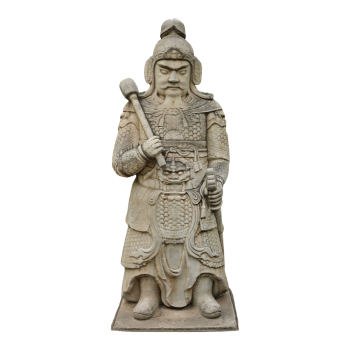
Ming Ming Mausoleum and Ming Maoling Statue "Stone Carving of Benevolent Beasts"

Ming Ming Mausoleum and Ming Maoling Statue "Stone Carving of Benevolent Beasts"

Starting from the two hexagonal stone pillars to the north of the Beiting Pavilion and ending at the Dragon and Phoenix Gate, on both sides of the kilometer long divine path, 24 stone beasts and 12 stone figures are neatly arranged, with vivid shapes and exquisite carvings, deeply loved by tourists. The large quantity, large size, exquisite carving, and good preservation of it are rare in ancient Chinese cemeteries. The stone figures are divided into four categories: meritorious officials, civil officials, and military officials, each with four statues. They were close attendants of the emperor during his lifetime, all of whom were standing statues with hands clasped in water, majestic and devout. The installation of such stone statues in imperial tombs dates back over two thousand years to the Qin and Han dynasties.
The Spanish Civil War Memorial "Eric Stanford"

The Spanish Civil War Memorial "Eric Stanford"

A fully restored Spanish Civil War memorial has been put back into use in Forbury Gardens. Reading Mayor Tony Jones presided over the event in the monastery district, with representatives from the borough council, unions, and other local groups also attending. The ceremony was held almost 25 years after the statue was first unveiled in May 1990. This monument was created by local sculptor Eric Stanford and, after four years of fundraising, depicts the mothers of those who died in Spain during the 1936-39 Civil War. At least 16 people from or associated with Reading were killed in the battle.
The Madonna and Child painting created by Michelangelo
The Madonna and Child painting created by Michelangelo

Michelangelo Bonaroti's painting of the Virgin Mary, created around 1547-1555. The Cathedral Opera House Museum in Florence, Italy. This painting of the Virgin Mary is Michelangelo's penultimate sculpture. In 1555, the elderly Michelangelo destroyed this sculpture after discovering a defect in the marble. In 1671, Cosimo III de 'Medici purchased the reconstructed sculpture and placed it in the basement of San Lorenzo Cathedral. In 1722, it was transferred to the Florence Cathedral.
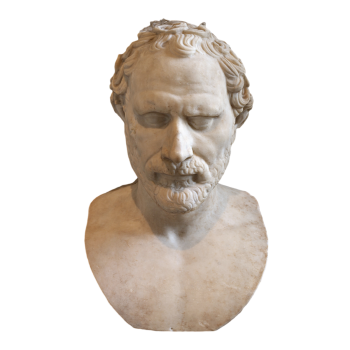
The bust of Demosthenes, a sculpture from the ancient Greek period in the 3rd century BC

The bust of Demosthenes, a sculpture from the ancient Greek period in the 3rd century BC

Demosthenes studied rhetoric from Isseus in his early years and taught rhetoric to Xuan. Subsequently, he engaged in political activities and strongly opposed Macedonia's invasion of Greece, delivering speeches such as the "Anti Philip Speech" to condemn the expansionist ambitions of Macedonian King Philip II. After the Battle of Catalonia (338 BC), he fled overseas. In 323 BC, Alexander III of Macedonia died and returned to Athens to organize an anti Macedonian movement. After failing, he committed suicide. The statue is currently housed in the Louvre Museum.
Monument to the Republic of Paris, 1879 National Square Monument

Monument to the Republic of Paris, 1879 National Square Monument

Ten years before the 100th anniversary of the French Revolution, the city of Paris launched a competition for the Honor Monument of the New Republic located in the east of Paris. The Morris brothers won the competition, and their Republic Monument is now located on Republic Square. But Jules Darrow's project attracted Paris city councilors, who commissioned him to make bronze for the current Place de la Nation. The victory of the Republic opened in 1899. As a fervent republican, Dalloway chose to provide impetus for his monument, leading humanity towards a new golden age.
Chinese white ceramic birthday star painted statue

Chinese white ceramic birthday star painted statue

Shouxing, also known as the Antarctic Elder Star, is the god of longevity in ancient mythology. He is also a deity in Taoism, originally named Xingxing and one of the three stars of fortune, fortune, and longevity. After Emperor Qin Shi Huang unified the world, he built the Shouxing Temple in Du County near Chang'an. The late birthday star evolved into the name of an immortal. The Ming Dynasty novel "Journey to the West" depicts the birthday star holding a lingzhi mushroom, with a long head, large ears, and a short body. The "Warning to the World" has a mythological story of "three stars of fortune, wealth, and longevity". The birthday star in the portrait is an old man with white beard, holding a staff and a raised forehead. The ancients symbolized the longevity of the elderly. Often accompanied by deer, cranes, immortal peaches, etc., symbolizing longevity.
The cast iron statue of the Sphinx in front of the French Military Museum

The cast iron statue of the Sphinx in front of the French Military Museum

The Sphinx statue stands between museums and streets in Paris. Made by Ducel Foundry, which was one of the most important foundries in France at that time.
The plaster statue of the dancer from the Sevres porcelain factory in France

The plaster statue of the dancer from the Sevres porcelain factory in France

The "Dancer" was made around 1900 at the Sevres Porcelain Factory in France by Agathon Leonard. It is currently housed in the Smithsonian Institution.
The marble statue "Ugolino and His Sons" collected in the Rodin Museum in Paris
The marble statue "Ugolino and His Sons" collected in the Rodin Museum in Paris

Ugolino and his sons are Ugolino marble sculptures made by Jean Baptiste Carpeaux in Paris in the 1860s. It depicts the story of Ugolino in Dante's Inferno, where a 13th century Count is imprisoned and starving with his children. This work is known for its expressive details, which opened up Karbo's career. It is currently housed in the Rodin Museum in Paris.
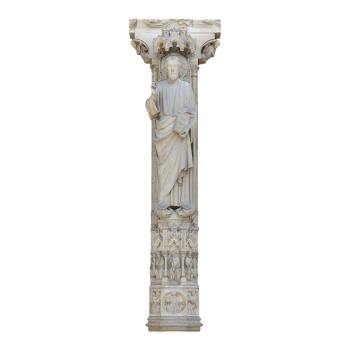
The carved stone pillar of Notre Dame Cathedral in Paris depicts the marble statue of Jesus

The carved stone pillar of Notre Dame Cathedral in Paris depicts the marble statue of Jesus

The Saint Etienne Gate of Notre Dame Cathedral in Paris is located south of the Seine River. The door depicts the life of the first Christian martyr, Jesus, through colorful paintings. It uses a butt joint arc to support the top of the cathedral walls, enhancing stability and solving the problem of no runoff rainwater discharge.
Baltimore City Monument Statue 'Mrs. Baltimore'

Baltimore City Monument Statue 'Mrs. Baltimore'

Lady Baltimore is located on the Battle Monument in the city center. Italian sculptor Antonio Capellano created the marble statue 'Mrs. Baltimore' in 1815. In the same year, this monument was adopted as the emblem of Baltimore, which also helped to give rise to the city's nickname "Memorial City". Interesting fact: Mrs. Baltimore's figure can be seen on the trash cans throughout the city.
The Bronze Statue of Zhou Dynasty's Respectful Posture

The Bronze Statue of Zhou Dynasty's Respectful Posture

This small and delicate figure stood with outstretched arms in a respectful posture. His curled fingers formed a socket that could grip the handle of the oil lamp. The character is wearing a long waistcoat with a regular waistband fixed by a belt hook around their waist. Throughout the entire Shang and Western Zhou dynasties (1600-771 BC), bronze figures were rare, but now several bronze figures have been unearthed from tombs of the Warring States period in the late Zhou dynasty as lamp posts. The strong sculptural quality of this character foreshadows the naturalism encountered in the subsequent Qin (221-206 BC) and Western Han (206-25 BC) eras.
The plaster statue of Avalokitesvara Bodhisattva sitting in Pakistan in the third century

The plaster statue of Avalokitesvara Bodhisattva sitting in Pakistan in the third century

This statue, known as the seated statue of Avalokitesvara Bodhisattva, was made in the 3rd to 4th century AD and originated from Pakistan. It is currently housed in the Jingci Art Museum and is made of plaster material. This sitting Avalokitesvara Bodhisattva wears a tall Tibetan style crown on his head, earrings hanging from his earlobes, his eyes slightly closed, and he meditates with a calm and relaxed facial expression, showcasing the unique charm of the plaster statue.
Shale statue of Shakyamuni half body from Peshawar, Pakistan in the third century

Shale statue of Shakyamuni half body from Peshawar, Pakistan in the third century

The half body statue of Buddha, made of shale in the 2nd and 3rd centuries, originated from Peshawar and is currently housed in the National Museum of Pakistan. Shakyamuni was like turning a wheel with both hands, wearing a huge bun on his head. He has regular facial features, a high nose, deep eyes, and a small beard on his lips. Wearing a robe with exposed right shoulder, the folds are very smooth. Strong in physique, it is the pinnacle of the Jiandala statue.
Statue of Bodhisattva Half Body during the Northern Wei Dynasty

Statue of Bodhisattva Half Body during the Northern Wei Dynasty

The statue is named a half body statue of a Bodhisattva and was made during the Northern Wei Dynasty. The site in front of the Yungang Grottoes was unearthed in 992 and collected by the Yungang Research Institute.
Maria Sobanska bust created by Konstantin Lashka

Maria Sobanska bust created by Konstantin Lashka

The name of the statue is "Maria Soba ń ska's bust", created by artist Konstanty Laszczka in 1918. This artwork is carved from Carrara marble and is a life sized sculpture. The details of this work are handled perfectly. Maria Sobanska was born into a powerful aristocratic family in Skarzky and lived from 1887 to 1948. It is currently housed in the Gorice Regional Museum.
Saiko and the Jar "created by Bertel Thorvaldsen

Saiko and the Jar "created by Bertel Thorvaldsen

The name of this cultural relic is "Saike and Jar", created by artist Bertel Thorvaldsen in 1806. This work is made of gypsum and is 1.32 meters high. It is currently housed in the Thorvaldsen Museum in Copenhagen, Denmark.
Mus é e d'Orsay in Paris and the Metropolitan Museum of Art in New York, "Ugolino and His Descendants"

Mus é e d'Orsay in Paris and the Metropolitan Museum of Art in New York, "Ugolino and His Descendants"

Ugolino and His Sons "is an academic creation by Calpo during his study abroad in Italy. According to the composition principles set by the academy, a sculpture is only allowed to have one to two characters. However, Karbo violated this rule by creating four characters first, and later dividing them into five characters to restore the authenticity of history, forming an inseparable group that is tightly intertwined. The reason why this theme fascinates Karl Bo is that he can fully express the psychological conflict between human and animalistic nature through male nudity, better showcasing his romantic passion and realistic expression techniques.
During the Tang Dynasty, the white stone sculpture "Changyang Taizun Stone Statue" was created

During the Tang Dynasty, the white stone sculpture "Changyang Taizun Stone Statue" was created

The Changyang Taizun stone statue was first carved in the seventh year of the Tang Kaiyuan era (719 AD) and is a precious resource for studying Taoism, ancient sculpture, and calligraphy art. The statue is made of white stone, one meter high, dressed in court attire, wearing a crown, with one hand supporting the knee and the other holding a belt, sitting on a stone seat with a dignified expression and smooth clothing patterns. Fuxi is one meter tall, with a bun on his head and curly long hair draped over his shoulders. He is wearing a shoulder and apron connected by leaves, holding the Bagua Taiji diagram in his hand, symbolizing Fuxi's creation of the Book of Changes.
Bronze Dragon Statue in Hue Royal City, Vietnam

Bronze Dragon Statue in Hue Royal City, Vietnam

The dragon of the inner city of Hue, Vietnam The bronze dragon was cast in 1842 and is located in front of the Yueshi Hall in Da Nei Fu, Hue City, Vietnam. The bronze dragon was cast in front of the Shunhua Imperial City in 1842.
Chinese Taipei Dalongdong Stone Carving "Bao'an Palace Mother Stone Lion"

Chinese Taipei Dalongdong Stone Carving "Bao'an Palace Mother Stone Lion"

Since ancient times, China has been skilled in using bamboo strips to enrich and express depth and vitality through the interaction of "facial" bamboo strips. In traditional Chinese Han stone carving, this characteristic is most vividly reflected in the mid Qing Dynasty. Taking the stone lion with the inscription "Respected to Emperor Du Youzhang of the Qing Dynasty in the 14th year of the Jiaqing reign" as an example, its cheeks, nose wings, arms, shoulders, and limb trunks can all be seen with "tassels" dividing them, creating a turning point in the moving surface. The ribbon at the foot is also cut at the contour tassel, forming a bright and vigorous face, and conveying the layered and thick body feeling of the ribbon flipping. This pair of stone lions were punished for violating regulations by carving the female lion into an opening due to the craftsman's carelessness, resulting in no salary.